
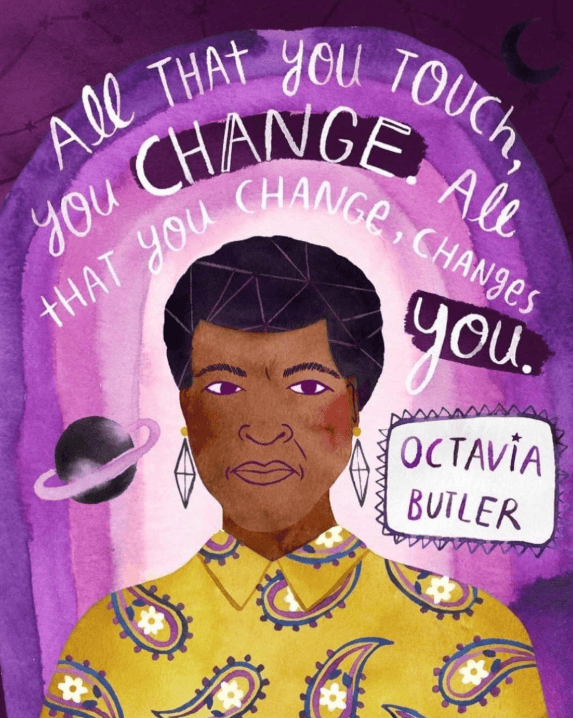
Recently I read Parable of the Sower by Octavia E. Butler, and what stayed with me wasn’t just the dystopian setting or the intensity of the protagonist, Lauren Olamina’s, journey. It was the simple, almost uncomfortable truth at the center of it: God is Change. Not “change is coming.” Not “change might happen.” Just—change is.
That idea has been sitting with me a lot lately as I attempt to settle into my new role here at work.
In the novel, Lauren grows up in a gated community that tries to keep the chaos of the outside world at bay. There’s this constant hope that if they just hold the line, things won’t fall apart. But they do. The walls don’t save them. What saves Lauren is something else entirely: her mindset. She doesn’t pretend change isn’t happening. She studies it. She prepares for it. She builds her Earthseed philosophy around it. Instead of asking, “How do I stop this?” she asks, “How do I shape this?”
That shift feels small when you say it. But it’s everything.
While I’m excited about my new role as SEM, it has definitely been a tough adjustment. My old routine? Gone. The comfort of knowing exactly how my days would unfold? Gone. Suddenly I’m navigating new expectations, new conversations, and a wildly different pace. And if I’m honest, my first reaction hasn’t always been graceful. I just don’t like change – I wanted to feel competent, immediately. I wanted things to click the way they used to.
And all of this disruption to my norm reminded me that change isn’t a glitch in the system—it is the system.
Lauren doesn’t survive because she’s the strongest or the luckiest. She survives because she adapts. She pays attention. She gathers people. She keeps moving. She understands that clinging to the way things were is a losing battle. The only real power she has is in how she responds.
That hit home for me.
I started noticing that most of my stress in less about the new role, but more so my reaction to a shift in my routine. When a meeting felt unclear, I’d get frustrated. When priorities shifted, I’d feel thrown off. But what if that discomfort wasn’t a sign that something was wrong? What if it was just growth happening in real time?
Thinking back to Parable of the Sower reminded me to slow down my reactions. Instead of resisting the disruption, I’ve been trying to apply some grit. What is this change teaching me? Where do I need to stretch? Where do I need to let go of control a bit? When do I say “NO”? That small pause—between something happening and my response to it—feels like the space where real authorship lives.
Work changes. Life changes. Roles evolve. Routines get shaken up. We don’t get to opt out of that. But we do get to decide whether we meet change with panic or with intention.
What I love most about Parable of the Sower is that Lauren builds her future while everything around her is unstable, and frankly quite grim. She doesn’t wait for things to calm down, and she’s not immune to grief or pain (quite the opposite, actually, if you read the book). She shapes her beliefs and her path in the middle of uncertainty, and fear, and that is the part that’s inspiring me right now.
I may not control every shift happening around me. But I can control how I show up to it. And in that steady, thoughtful response—that’s where I start to write my own story.
-Starla Ford
P.S. I HIGHLY recommend anyone that loves a good dystopian or speculative fiction novel to read Parable of the Sower. It was written over 30 years ago, and frankly the most frightening aspect of the novel was how immediate and present her writing feels in today’s world. Head to your local library or use the link I’ve included below to grab a copy. 🙂
https://bookshop.org/p/books/parable-of-the-sower-octavia-e-butler/3d0d65170d5548df