
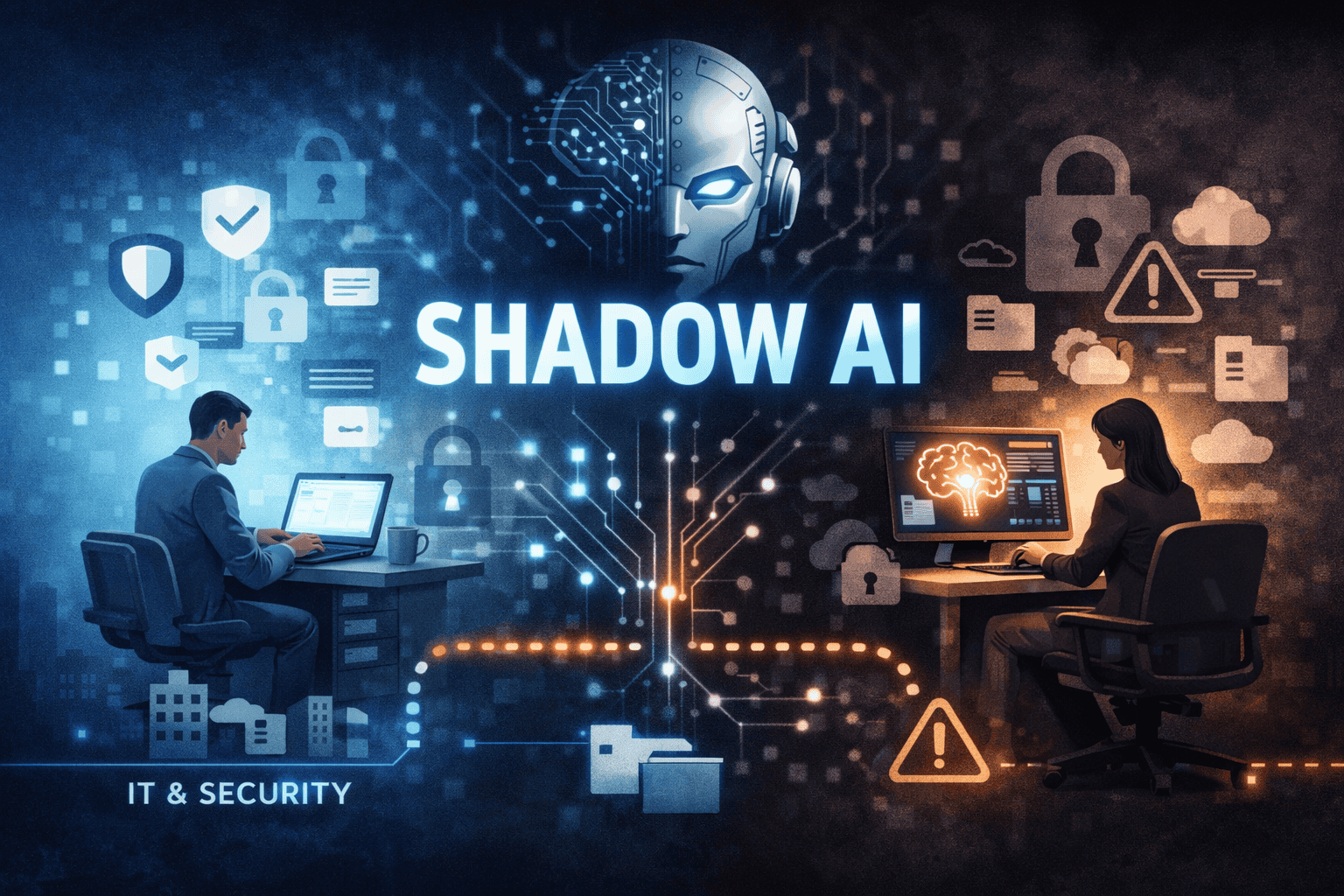
Artificial intelligence is no longer a future concept, it is embedded in the day-to-day workflows of modern organizations. From drafting emails to analyzing data and automating repetitive tasks, AI tools help users work faster and more efficiently. However, alongside officially approved solutions, a quieter trend is emerging across workplaces: the rise of Shadow AI.
Shadow AI refers to the use of AI tools and platforms by users without formal approval or monitoring from an organization’s IT or security teams. Much like Shadow IT, which is the use of IT services within the organization without the knowledge of the IT department, this phenomenon is often driven by good intentions. Users are not attempting to bypass policies maliciously; rather, they are seeking ways to improve productivity, solve problems quickly, and keep up with evolving technological capabilities.
The accessibility of AI tools has made Shadow AI particularly widespread. Many apps and services are free or require minimal setup, allowing users to integrate them into their work at ease. Whether it is using a chatbot to summarize documents, generate code, or draft communications, these tools can significantly reduce time spent on routine tasks. In environments where official AI solutions are limited or unavailable, users naturally turn to external tools to fill the gap.
Despite its benefits, Shadow AI introduces a range of risks that organizations cannot afford to ignore. One of the most significant concerns is data security. Users may unknowingly input sensitive or proprietary information into public AI systems, potentially exposing confidential data. This can lead to compliance violations.
In addition to security concerns, the lack of monitoring presents another challenge. Without visibility into how AI tools are being used, organizations cannot ensure that outputs are accurate, unbiased, or aligned with business standards. AI-generated content, while powerful, is not infallible.
There are also important considerations around intellectual property. When proprietary data is shared with third-party AI tools, organizations may lose control over how that data is stored, processed, or potentially reused. This creates uncertainty around data ownership and protection—issues that are still evolving in the broader AI landscape.
However, it is essential to acknowledge that Shadow AI is not solely a negative phenomenon. In many ways, it reflects users who are engaged, innovative, and eager to adopt new technologies. Rather than attempting to eliminate Shadow AI entirely, organizations can focus on managing it effectively. Establishing clear policies around AI usage is a critical first step. Users need guidance on what tools are approved, what types of data can be shared, and how to use AI responsibly. These policies should be practical and enable productivity, not restrict it unnecessarily.
Shadow AI is ultimately a reflection of how quickly technology is evolving and how quickly users are adapting. Organizations that acknowledge this shift and respond with thoughtful governance and training will be able to capitalize fully on this trend.